From Origin to Organization
If Africa is where humanity begins, it’s also where humans first learned how to live together at scale.

As populations grew and environments shifted, African societies developed ways to organize food production, land use, and community life that were suited to their regions and climates. These systems didn’t follow a single path. They emerged independently, across multiple parts of the continent, in response to local conditions and collective needs.
Archaeological evidence shows that agriculture developed in Africa at least five separate times, in different regions and among different peoples. Crops like sorghum, pearl millet, teff, African rice, yams, and cowpeas were domesticated locally, supporting long-term settlement and population growth. These were not experimental or temporary solutions… They formed the backbone of stable societies for thousands of years.
Genetic and botanical research has identified more than 60 plant species that were domesticated within Africa. Some of these crops later spread beyond the continent, shaping agriculture in Arabia, South Asia, and eventually the Americas. Long before global trade routes were named or mapped, African agricultural knowledge was already moving outward.
What emerges from this record is not a single “first,” but a pattern: African societies repeatedly solved the same fundamental challenges of human life, food security, sustainability, and cooperation, in sophisticated and enduring ways.
It is a history of development, innovation, and continuity, rooted in place, shaped by people, and sustained over millennia.
Food as the Foundation for Expansion
Across the African continent, early societies developed food systems that were closely tied to local landscapes, climates, and seasonal patterns. Rather than relying on a single agricultural model, communities adapted cultivation practices to arid zones, river valleys, highlands, and forested regions.
Sorghum, one of the most important grains in the world today, was domesticated in eastern Sudan, in the region around the Rivers Atbara and Gash, more than 5,000 years ago. Pearl millet was being cultivated in the western Sahel, in what is now Mali and Mauritania, by the third millennium BCE. Teff, a grain from the Ethiopian highlands that's still a staple food in Ethiopia today, was domesticated locally.
These crops supported different patterns of settlement and labor. Some regions favored mobile farming and seasonal movement; others supported permanent villages and food storage. Over time, this agricultural diversity allowed populations to grow while maintaining ecological balance.
Across different regions and kingdoms, societies domesticated a wide range of plants beyond grain, including cowpeas, yams, African rice (Oryza glaberrima - a species distinct from Asian rice), and oil palm (the source of palm oil). Together, these crops formed regional food systems that sustained communities over thousands of years and allowed for specialization in crafts, trade, and governance.
Agriculture across Africa was not a single invention or a uniform practice. It was a set of locally grounded solutions to shared human challenges: how to feed communities, manage land, and survive across generations.
The Bantu Migration: Agriculture on the Move
One of the largest and most important migrations in human history didn’t make it into most school curricula. It’s called the Bantu Migration; and it reshaped an entire continent.
The word “Bantu” literally means “people.” It comes from a common linguistic stem shared across hundreds of African languages. Today, over 500 languages spoken across central, eastern, and southern Africa trace back to one ancestral language: Proto-Bantu. That’s not a coincidence. It’s the linguistic fingerprint of a massive, slow-moving migration that began around 2000–1500 BCE in the region between modern-day Nigeria and Cameroon.
The proto-Bantu were farmers, who cultivated pearl millet and yams. They also made pottery, and critically, they knew how to work iron, which we’ll get into goods, on the next post later today February 3rd or tomorrow February 4th.
As climate shifted and rainforests receded, small groups of Bantu-speaking peoples began moving south and east, not as a single army or conquest, but as waves of families and communities settling new land over centuries. They carried their agriculture, their ironworking, their languages, and their ways of life with them.
By the time they were done, Bantu-speaking peoples had reached as far as the Great Lakes region of East Africa, the coast of modern Tanzania and Kenya, and eventually all the way to southern Africa. They didn’t just move through, they interacted. They traded with, learned from, and intermarried with the peoples already living in these regions. Bantu oral tradition even holds that rainforest dwellers like the Twa peoples taught them how to adapt to new environments.
The result? One of the most connected cultural and technological networks in ancient history. Iron tools. Farming techniques. Pottery. Language. All of it spreading across sub-Saharan Africa, not because of colonization, but because of people moving, building, and sharing knowledge across generations.
The Kingdoms: This Is What They Left Out of the Textbook
Yesterday’s stack teased them. Now we’re here.
Africa didn’t just have farms and villages. It had empires. Powerful, sophisticated, politically organized empires that controlled trade routes, built monuments, developed their own written languages, and made the rest of the ancient world pay attention.
Here are four of them. And not a single one shows up in most American history classes.
Kemet (Ancient Egypt) - But Let’s Actually Talk About It
Most people know Ancient Egypt. What most people don’t know is that it was an African civilization - rooted in the Nile Valley, built by African peoples, and fundamentally part of the African story.
The ancient Egyptians called their homeland Kemet - which translates to “the Black Land,” named for the fertile dark soil along the Nile. This wasn’t a civilization that appeared out of nowhere. Its roots stretch back into the pre-dynastic cultures of the Nile Valley, with connections to the peoples and cultures of Nubia to the south.
Kemet gave us the pyramids, hieroglyphic writing, advanced mathematics, medicine, and one of the longest-lasting civilizations in human history, over 3,000 years. But here’s the thing: the way Kemet is taught strips it of its African identity. Museums, textbooks, and movies routinely present Ancient Egypt as a civilization that existed somewhere between Europe and the Middle East, not as what it was: an African civilization, on African soil, made by African people.
That’s Eurocentrism doing its work again. We covered why in Day 1. Today, we just want you to see it.
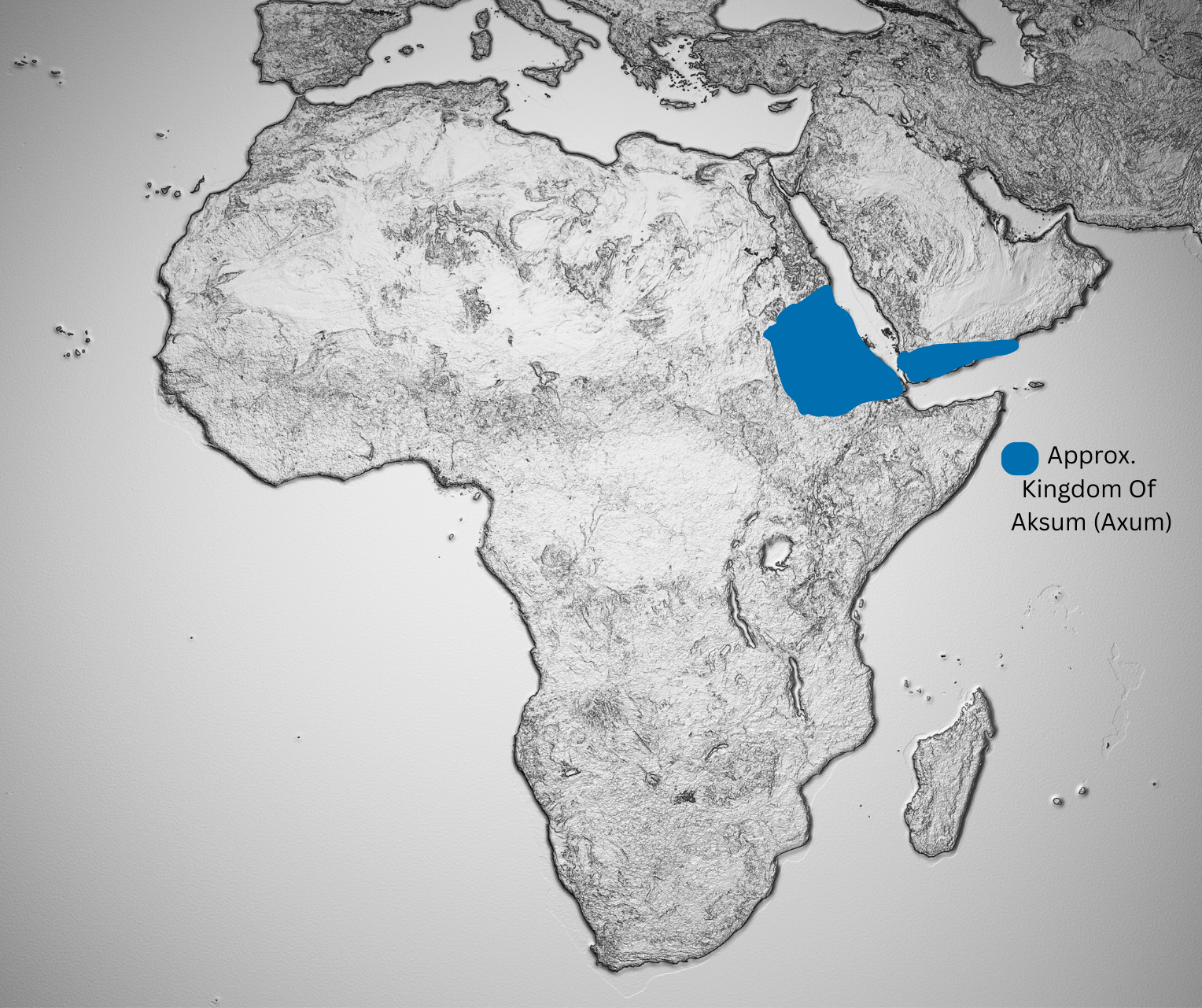
Aksum - The Empire That Rivaled Rome
In what is now northern Ethiopia, an empire rose that the Persian Prophet Mani considered one of the four greatest powers in the world, alongside Rome, Persia, and China.
That was Aksum.
Aksum emerged around the 1st century CE and, at its peak between the 3rd and 6th centuries, became the greatest trading hub in northeastern Africa. Its port city of Adulis (Modern day Eritrea) sat on the Red Sea, giving Aksum direct access to trade routes linking the Mediterranean, Arabia, India, and beyond. Roman merchants, Egyptian traders, Persian merchants, they all came through Aksum.
And Aksum wasn’t just a crossroads. It was a builder. Aksumite kings erected massive stone obelisks, some carved from single blocks of granite and standing over 30 meters tall, to mark royal tombs. The largest, the Great Stela, weighed over 570 tons. It was among the largest monolithic sculptures ever created and transported in human history.
Aksum developed its own alphabet, the Ge’ez script, which is still used in the Ethiopian Orthodox Church today. It minted its own coins in gold, silver, and bronze. In the 4th century CE, under King Ezana, Aksum became one of the first states in the world to officially adopt Christianity, predating most of Europe.
Aksum is one of the oldest inhabited areas on Earth, and what’s unbelievable is that this isn’t going to be found in a standard history lesson in the US or most elsewhere in the world for that matter.
Nubia and the Kingdom of Kush - The Black Pharaohs
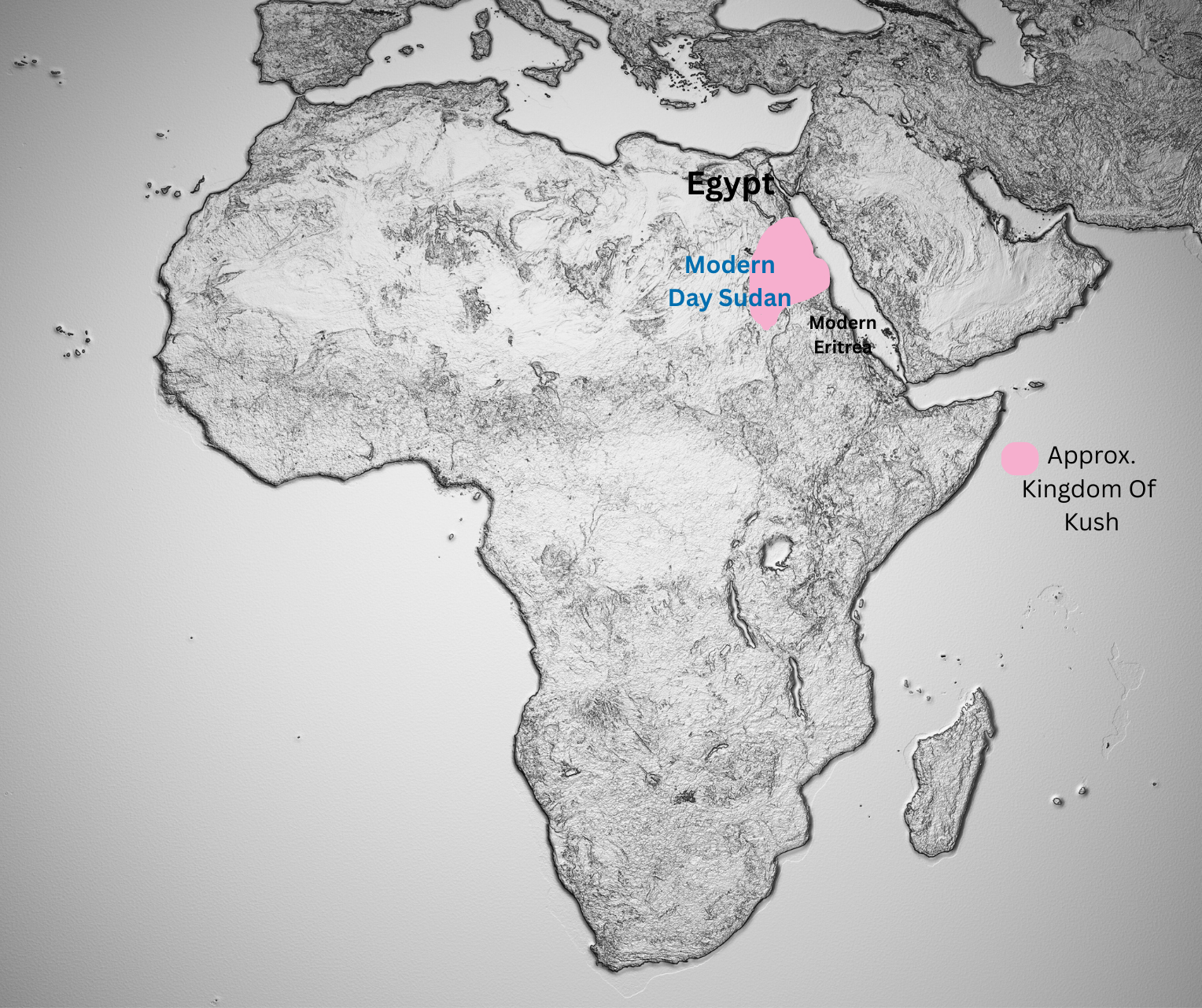
South of Egypt, along the Nile in what is now Sudan, a civilization rose that didn’t just rival Egypt, it conquered it.
The Kingdom of Kush, centered in ancient Nubia, thrived for nearly 3,000 years. Its kings, known as the Black Pharaohs, marched north in 747 BCE and seized control of Egypt, establishing the 25th Dynasty. For nearly a century, a Kushite king sat on the throne of Egypt.
But Kush wasn’t just a military power. It was an industrial one.
At its later capital of Meroë, the Kushites became expert ironworkers. Archaeological excavations have uncovered vast furnaces and slag heaps, evidence that Meroë was one of the great industrial centers of the ancient world. The city also sat at the crossroads of inland African trade routes and caravan trails from the Red Sea. Iron, gold, ivory, all of it flowed through Meroë.
And then there are the pyramids. Kush built more than 200 pyramids at the necropolis at Meroë, giving Sudan more pyramids than all of Egypt. They’re smaller and steeper than the Egyptian ones, but no less striking. They stand today as monuments to a civilization that the rest of the world forgot about.
Nubia also produced powerful queens that were independent rulers. The Kushite queens, Kandakê (latinized as Candaces), ruled with authority. The most famous of which is Queen Amanirenas who led a 3 year war against the Roman Empire, at the time one of the most widespread in the world, and she successfully stopped the romans from pushing further into the continent. Eventually they did push past the Kush region but Queen Amanirenas was able to sign a peace treaty with Emperor Agustus that lasted until the 3rd century.
The Ghana Empire - The Land of Gold
West Africa. Before Mali. Before Songhai. Before any of the empires you might have heard of, there was Ghana.
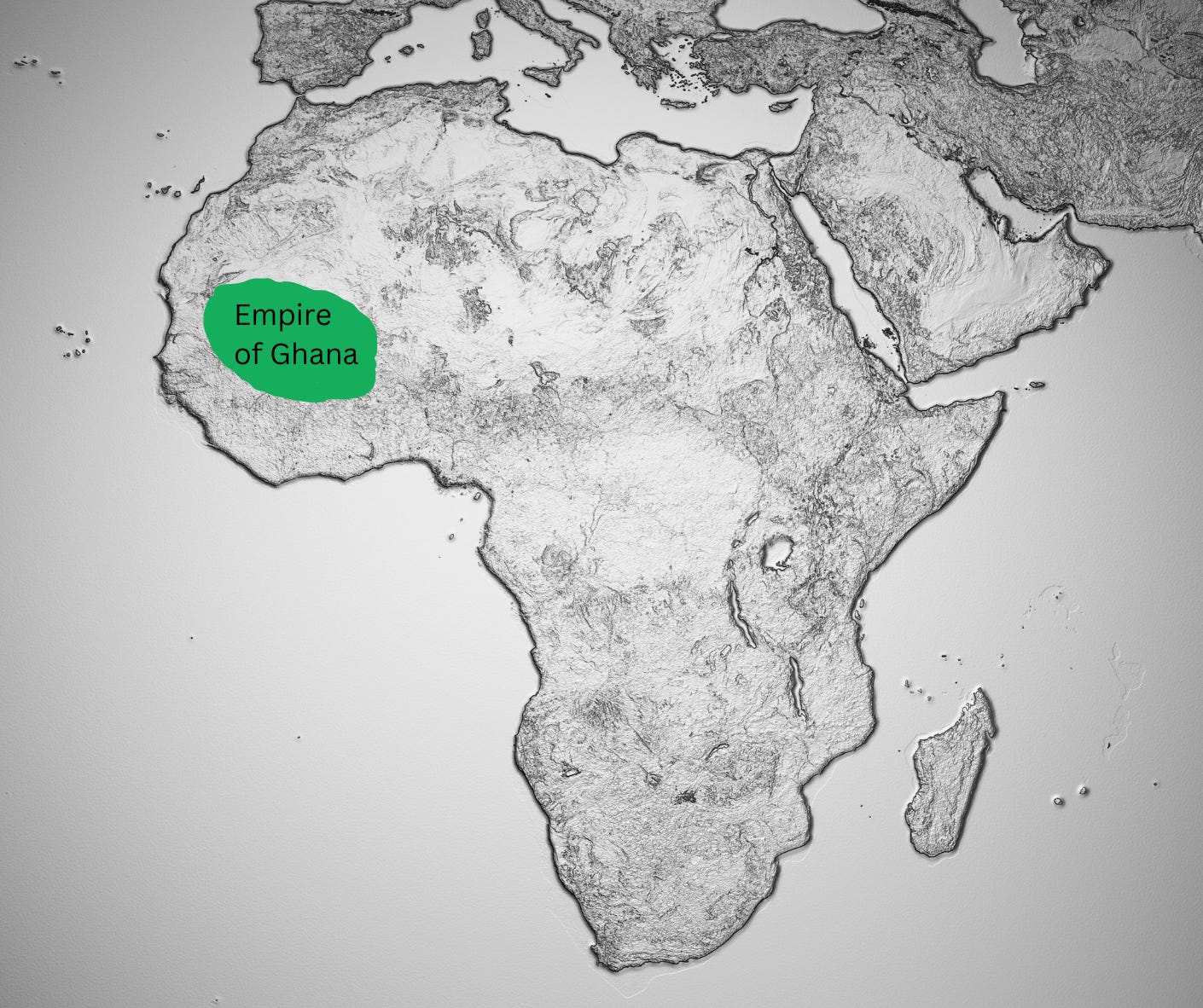
The Ghana Empire, also called Wagadou, was built by the Soninke people in what is now southern Mauritania and western Mali. It rose to power between the 6th and 13th centuries CE, and it dominated one thing above all else: gold.
Ghana sat at the crossroads of the trans-Saharan trade routes. Gold was mined in the regions to the south. Salt came from the Sahara to the north. Ghana controlled the flow between them, and taxed it. Merchants paid duties on what they brought in and what they took out. The king kept all gold nuggets for himself and allowed traders to handle only gold dust, a simple strategy that kept the price high and the empire richer than almost anywhere else on Earth.
Arab travelers in the 8th and 9th centuries wrote about Ghana with awe. One called its king “the wealthiest king on the face of the earth.” At the trade’s peak, two-thirds of the gold moving around the medieval Mediterranean came from West Africa, and Ghana was at the center of that flow.
Ghana’s capital, Koumbi Saleh, was a cosmopolitan city, a Muslim merchant quarter alongside the royal court of the Soninke king. It was a place where cultures met, traded, and coexisted. And it powered an economy that shaped the medieval world.
Why This History Matters During Black History Month
Black History Month is often taught as a story that begins with enslavement, or, at best, with survival under oppression. What gets lost in that framing is the deeper truth: Black history did not begin in crisis. It began in creation.
Remembering this history during Black History Month is not about reclaiming pride for pride’s sake. It is about restoring context. It is about understanding that the forced displacement of African peoples through slavery interrupted civilizations that were already complex, organized, and globally connected.
Black history does not start with loss. It starts with capacity. It starts with knowledge, systems, and culture that existed long before colonization or enslavement, and that continued to shape the world even after attempts to erase them.
The Gap This History Exposes
When African civilizations are removed from the story of human development, the gap that forms is not just historical. It’s moral.
Erasure makes inequality easier to justify.
But the history laid out here makes one thing impossible to ignore: many of the people who were forcibly removed and sold into slavery did not come from “nothing” or were “fighting each other”. All enslaved African people came from societies with established political systems, trade networks, spiritual traditions, and generational wealth; they were artisans, farmers, scholars, leaders; and some were even royalty in their own homelands.
They were not taken because they lacked civilization.
They were taken despite it.
Expose The Gap stands for integrity, which means telling the truth even when it dismantles comfortable narratives. It stands for compassion, which means realizing the biases we hold, the perceptions we continue to uphold, and refusing to reduce human beings to what was done to them. And it stands for community, the recognition that what was stolen from some of us diminished all of us.
This history is about restoring context. When we see African societies as they were; organized, innovative, and deeply human; it becomes impossible to accept modern inequality as natural or deserved.
The gap was constructed.
And what was constructed can be confronted, challenged, and changed, together.
Expose The Gap: Core Values
Integrity - Boldness - Compassion - Curiosity - Community
This series is community driven. If you have stories, sources, corrections, or perspectives you think belong here, we want to hear from you.
Exposing the gap isn’t a solo effort.
And it never has been.
📧 Email us: info@exposethegap.com
Check out our website below:
Want to help fuel this collective?
See the forms below to give us some background, clarity and lend your voice towards change by helping us tell lived experiences.
Sources:
"Plant studies show where Africa's early farmers tamed some of the continent's key crops" — Science / AAAS. Genetic analysis tracing pearl millet, African rice, and yam domestication to West Africa. https://www.science.org/content/article/plant-studies-show-where-africas-early-farmers-tamed-some-continents-key-crops
"The Invention of Agriculture in Africa: Plant Domestication and the Spread of African Crops to Asia and the Americas" — African History Extra (Substack). Comprehensive overview of Africa's five independent domestication centers and 60+ native crops.
"The Bantu Migration" — World History Encyclopedia. Overview of Bantu expansion, its causes, routes, and cultural impact. https://www.worldhistory.org/Bantu_Migration/
"Africa's Merchant Kings" — Archaeology Magazine (July/August 2023). Archaeological research on Aksumite trade, the port of Adulis, and pre-Aksumite cultures. https://archaeology.org/issues/july-august-2023/features/aksum-ethiopia-eritrea-kingdom/
"In the Land of Kush" — Smithsonian Magazine. In-depth feature on Nubia's civilization, Meroë's pyramids, and the kingdom's legacy. https://www.smithsonianmag.com/travel/sudan-land-kush-meroe-ancient-civilization-overlooked-180975498/
"The Ghana Empire" — World Civilization / Lumen Learning. Overview of Wagadou's origins, trade systems, and political structure. https://courses.lumenlearning.com/suny-hccc-worldcivilization/chapter/the-ghana-empire/
"The Trans-Saharan Gold Trade (7th–14th Century)" — The Metropolitan Museum of Art. Scholarly essay on gold trade routes linking West Africa to the Mediterranean. https://www.metmuseum.org/essays/the-trans-saharan-gold-trade-7th-14th-century
